
Rooted in Place:
The Story of Crawford
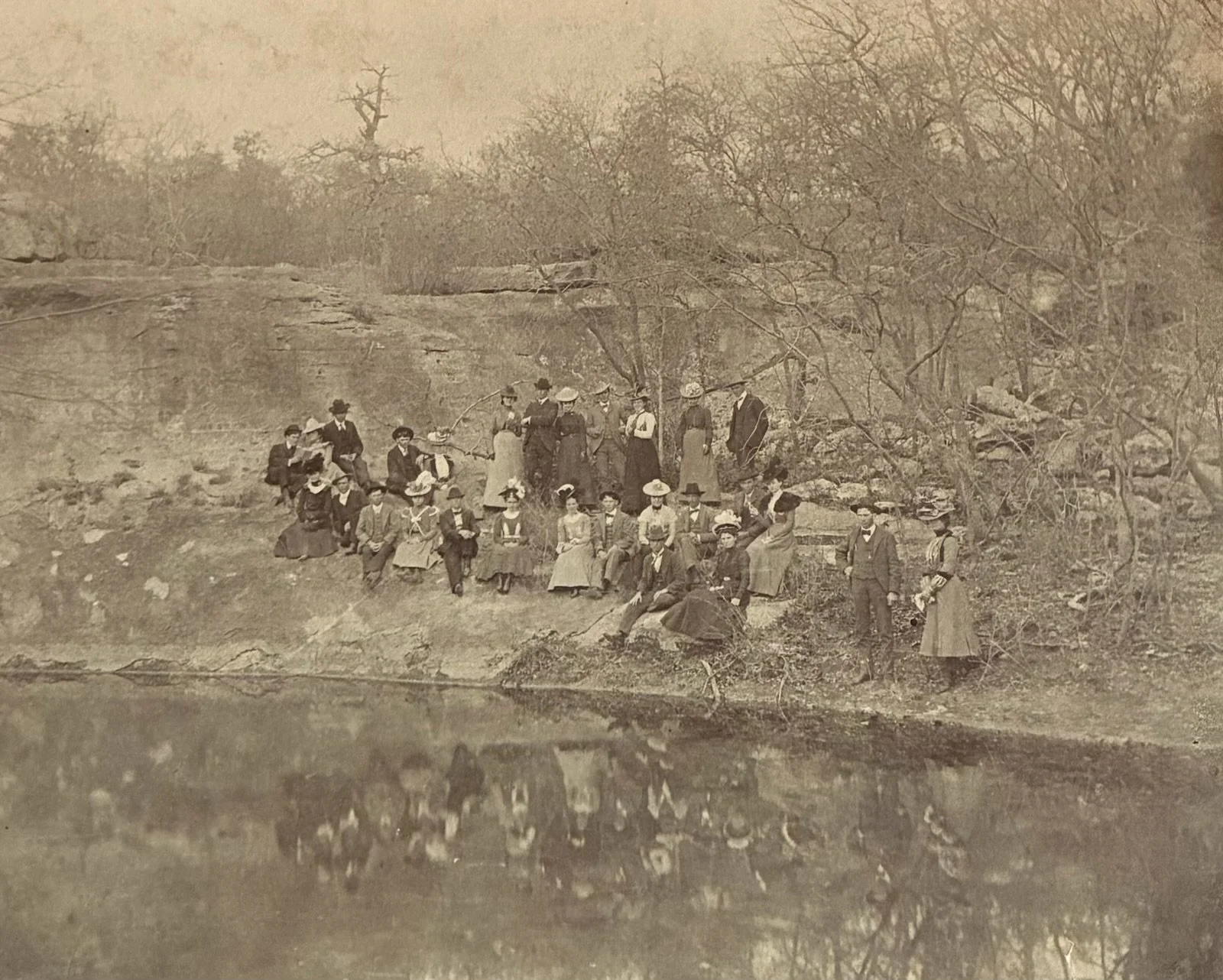
Crawford history begins thousand of years ago, when indigenous people used the caves along Tonkawa creek and left behind artifacts testifying to their presence. From as early as 4000 BC to the 1700s, the 5 caves near present day Crawford played host to native wanderers as they camped along the creek below the falls. At some point, indigenous people left carvings above the falls that speak to us today across the millennia of time. Such petroglyphs are relatively uncommon in Central Texas and represent one of Crawford’s most important archaeological resources.
The name of Tonk Creek indicates the possible presence of at least some Tonkawa people around the time Texas explorers and surveyors were putting place names on the areas they were mapping. Pushed from Oklahoma to Texas by the Comanche in the 17th century, the Tonkawa inhabited lands from present day Georgetown down to San Marcos in the 1700s. They frequented the Spanish missions on the San Gabriel River, but resisted religious conversion.
Squeezed yet again by the Comanche and Apache in the first half of the 1800s, the Tonkawa were forced to leave their buffalo hunting grounds to roam the rivers and creeks farther north, hunting smaller game. Scattered, and their numbers dwindling, some may have camped in the vicinity of the creek and encountered Texans, resulting in the naming of the creek.
Although the Tonkawa served in critical roles as scouts for the Texas Rangers and the US Army, in the early 1850s the US government forced them onto a series of reservations. Decimated by a massacre carried out by other tribes in retaliation for the scouting, and by the atrocious conditions on the reservations, their very existence was threatened. A handful of Tonkawa finally ended up back in Oklahoma, after a forced march known as the Tonkawa Trail of Tears. The present day town of Tonkawa, Oklahoma is named for them.
The modern history of Crawford began with land grants, a river crossing, and the intersection of two important roads. The Texas government granted land to Jerome B. Robertson in 1845 for his service in the Texas Army. The Robertson grant included present day Crawford, much of Tonk Creek and some of Wasp Creek, and a large section of the Middle Bosque River. But although Robertson and many others received grants of land in the Crawford area, the census and tax rolls do not show settlement of these grants prior to 1867. Pioneers did not really rush into the Crawford area until after the Civil War ended in 1865 and the dust had somewhat settled. Wagonloads of families left the South, some with former slaves traveling with them, and either bought land in the area or used Confederate Scrip to obtain a land grant. Others claimed land through military service to Texas or in the Indian Wars, or through the Homestead Act. A very few brought great wealth to the area and set up large ranches, raising horses, cows and/or sheep. All of these early settlers made their claims along the waterways of the area: the Middle Bosque River, Hog Creek, Bluff Creek, Wasp Creek and Tonk Creek.
The first signs of a potential town developed near a ford on the Middle Bosque River at the mouth of Tonk Creek. Locals called it The Fork, but it was also known generally as Tonk Crossing. Early explorers and surveyors used the ford, and the Waco to Gatesville Road established in 1852 crossed the Middle Bosque at Tonk Crossing. Traveling up Tonk Creek, another road that had been established in 1849 from Belton to Ft Graham intersected with the Gatesville Road. Both roads are labeled on maps from the 1850s, and along with the river crossing they strongly encouraged settlement of the area. In 1867 the Brownwood Stage Line, carrying mail and passengers on the Waco to Gatesville Road, established a remount station at Tonk Crossing and a tiny community sprang up. Nelson Crawford improved and graded the difficult river crossing, and by 1871 the settlement increasingly became known as Crawford in his honor.
In 1871 the first post office in Crawford identified Jon Hamlin as its first postmaster. Although Hamlin was only in Crawford for a short time, it is likely he ran the first store, with the post office located in the back. An “inn” soon joined the remount station, possibly just one room in a small cabin as was typical on the frontier. The earliest settlers included “Tonk” Baker who raised horses along Tonk Creek, the Saddlers who raised livestock and employed wagoners and cattle drivers along Wasp Creek, and the Tubbs family with large holdings all along the Middle Bosque. Felix Robertson, son of Jerome, settled nearby. The Bibles bought land on Bluff Creek, the Fords settled just south of them, and Witte, Downs and Costley filled in along the Middle Bosque. Meredith joined Baker on Tonk Creek and Miller started a sheep ranch on Wasp Creek. These early settlers were influential in the development of the little “town” at the crossing, and the larger community that grew up around it.
Uriah Tadlock, one of the true “founders” of Crawford, bought land in 1872 on Tonk Creek, just before it curves down toward the Falls. Tadlock eventually opened a store on his land and became the second post master, moving the mail to his store. He sold “town lots” and donated land for the Crawford Cemetery, the school, and the Methodist church. The area that would come to be known as “Old Crawford” now served as the heart of the community. By 1878, the “small country village” boasted two stores, a school, a blacksmith shop, the former “Crawford Tavern” that rented rooms, a post office and a drug store. However, the river crossing continued to be vital, and Crawford sported homes that doubled as businesses strung out from Tadlock’s “town center” all the way down to The Fork and along Wasp Creek as well.
We know details about “Old Crawford” because of a young school teacher named J.B. Cranfill who later wrote and published his memoirs. He describes the little town, its early leaders, and even a bit about daily life in 1878. With only one assistant he taught 100 students who came from the countryside all around Crawford, and he courted the oldest Allen girl. (The Allens had settled both sides of the Middle Bosque as it began to approach The Fork. The Saddlers owned both sides of the river crossing.) Mr. Cranfill and Miss Allen married and moved on, but Crawford always held a special place in his memories.
In 1880 the city leaders began to work with the G.C.&B.F.R. Railroad as it planned its route north from McGregor toward Valley Mills. Choosing the flattest and straightest path, which railroad companies always did, the tracks would miss the little village of Crawford by half a mile or more. So Felix Robertson sold the railroad the land for a new town to be built in the current location. Uriah Tadlock sold the the right of way through his land north of town, with the condition that the depot was to be built within a half mile of his home. In 1881 much of the town of Crawford quite literally picked up and moved to its new site. Tadlock built several rock buildings, including the one that is currently the oldest building in Crawford, with the Tadlock name still on the threshold. James B. Nichols opened a store and Benjamin Brown’s house became the first home in Crawford, moved there by mules from what soon became known as “Old Crawford.” The local leaders set up a trustee form of city government and town lots sold like hotcakes.
By 1885 Crawford had become a bustling cotton town, although other crops and stock were also shipped on the railroad. The train stopped at the Crawford Depot multiple times throughout the day, as passengers and goods moved on and off. Main Street boasted a variety of businesses, and scattered nearby were a gin, several churches, a hotel and a school. The quarry near Tonk and Wasp creeks mined limestone as early as 1887. The Crawford Independent School District came into existence in 1894, and an election at Tadlock’s store named five trustees: Meredith, Bewley, Graves, Allen and McCollum. Many smaller schools continued to serve areas around Crawford, but school consolidation had begun.
In 1907 M. Marks opened a general store in Crawford after laying the cornerstone for the building that would later become Amsler’s, still a landmark in Crawford today. In the early 1900s, Crawford hit its zenith for the century, with a population of 610 and 35 thriving businesses. These included 5 general stores, a couple of meat markets, several gins, at least six churches, two banks, drug stores, cafes, and before long service stations and new car dealerships. Residents approved a bond in 1903 to build a two story, four room limestone rock school “on the city’s western border.”
While the 1920s brought an early Depression for farmers, the school continued to grow. A brick veneer covered the limestone and new wings were added in 1926, along with the only indoor gym in McLennan County outside of Waco, which became a source of immense local pride. In addition to competing in basketball, the school fielded its first football team in 1927. A refurbished Ford truck made its debut as the first school bus, and the school published its first yearbook in 1928.
The Great Depression hit Crawford hard, and many farmers and business owners needed work. In 1933 the town learned that the Civilian Works Authority, a government program that was a precursor to the PWA, was offering Crawford a choice: build a city sewage system or create a park at Tonkawa Falls. The city voted to create a park and put many Crawford residents to work in 1933 and 1934 building roads, dams, retaining walls, steps, picnic tables, fire pits and camping sites, a pavilion with a concession area, and a caretaker’s cottage. Tonkawa Park has been treasured by Crawford residents ever since, and is recognized statewide as a place of exceptional natural beauty.
The Campfire Girls built cabins and a dining hall and used Tonkawa Park for their summer camps in the early 1940s. After they left for Val Verde, Crawford School turned their riding arena into a football field. Bomb racks from the WWII Bluebonnet Plant in McGregor were turned into bleachers and the field became the home of the Pirates in 1946. In 1948 the school held its first homecoming, with a banquet, special speakers and entertainment prior to the big game. In addition to the excitement of football, Crawford exes saw halftime entertainment from drummers, twirlers and cheerleaders, as well as the crowning of a football sweetheart.
By the mid-1900s, life had changed drastically in Crawford. New automobiles were sold on one end of Main Street while a movie theater showed news reels, cartoons, serial westerns and feature movies at the other end. Highway 317 linked Crawford to McGregor and Valley Mills, and FM 185 made it much easier to get to Waco. On Saturday afternoons and evenings, the little town was hopping with all the farm families who had come in for the day. Circuses and medicine shows set up tents, the cafes were open, and the stores were filled with shoppers. Kids rode the arm of the city water well up and down like a carnival ride, laid pennies on the tracks as they waited for the train, and begged their parents for an ice cream soda at the drug store.
The school also offered local entertainment. In addition to basketball, football, baseball and track, there were Coronations, Junior and Senior Plays, band and choir performances, PTA programs, and more. Local churches and organizations offered Womanless Weddings, Donkey Basketball, chili suppers, Christmas bazaars and other social events throughout the year.
But as travel to Waco increasingly became faster and easier, Crawford’s population began to decline. Businesses began to close. Life became increasingly centered around the school as more and more residents found jobs other than farming in places other than Crawford. The businesses anchoring Crawford in the second half of the 20th century included the quarry, Amsler’s, several gas stations and repair shops, the feed store and the Co-Op. One hair salon begun in the middle of the 20th century still operates today.
Despite fewer businesses, the school and the residents of Crawford continued to thrive. The boys’ football team became a powerhouse as did the girls’ basketball team, which competed at state 4 years in a row, bringing home the school’s first state championship in 1976. When Crawford entered UIL academic competition in the 1970s, students brought home state championships there as well. A housing development offered brand new homes in Crawford and the median income level rose, as did the level of education. A community center hosted celebrations of all kinds, and the local churches built new sanctuaries and Sunday School buildings. A seafood restaurant opened at Tonkawa Park and customers drove from miles away for both the food and the view.
In the 1990s, Crawford took a hit to the heart when Amsler’s closed, unable to compete with the big grocery store chains in Waco. Students descriptions in a school writing assignment referred to Crawford as a “ghost town” because Main Street offered so few businesses. Even the restaurant at the park was gone. The school racked up numerous awards and consecutive Exemplary ratings from TEA, but the town itself showed only glimpses of life. However, all that was about to change when the governor of Texas, son of a former President, bought the Engelbrecht ranch on Prairie Chapel Road just outside Crawford.
The purchase of the Prairie Chapel Ranch by Governor George W. Bush in 1999 would bring unprecedented national and international attention to Crawford. Reporters, world leaders, protestors, and tourists soon arrived in a community that had spent more than a century quietly building its identity through agriculture, education, faith, and neighborly ties. While the spotlight transformed how outsiders viewed Crawford, the values that had sustained the town since the days of Tonk Crossing—community, perseverance, and pride in place—remained largely unchanged.
Today Crawford continues to balance its small-town heritage with its unique place in American history. From ancient peoples along Tonk Creek to modern generations attending Crawford schools, the story of Crawford remains one of connection: to the land, to family, and to one another.